Floor Speech2026-03-18
Text of Senate Amendment 4470
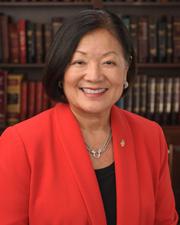
Mazie K. Hirono
DHI · Senator
Full Text
Text of Senate Amendment 4470

Congressional Record, Volume 172 Issue 49 (Wednesday, March 18, 2026) [Congressional Record Volume 172, Number 49 (Wednesday, March 18, 2026)] [Senate] [Pages S1214-S1217] From the Congressional Record Online through the Government Publishing Office [ www.gpo.gov ] SA 4470. Ms. HIRONO submitted an amendment intended to be proposed by her to the bill S. 1383, to establish the Veterans Advisory Committee on Equal Access, and for other purposes; which was ordered to lie on the table; as follows: Strike title II and insert the following: TITLE II--GENDER EQUITY IN EDUCATION SEC. 201. SHORT TITLE. This title may be cited as the ``Patsy T. Mink and Louise M. Slaughter Gender Equity in Education Act of 2026''. SEC. 202. FINDINGS. Congress finds the following: (1) Title IX of the Education Amendments of 1972 (20 U.S.C. 1681 et seq.) and the implementing regulations of title IX prohibit sex discrimination in federally funded education programs and activities. (2) Although title IX requires that schools treat students equally with regard to athletic participation opportunities, athletic scholarships, and the benefits and services provided to athletic teams, female participation rates, especially for girls of color, lag far behind male participation rates. Nationally, for example, boys receive more than 1,000,000 more opportunities to play high school sports than girls. Furthermore, although girls comprise nearly 50 percent of high school students, schools provide them with only 43 percent of athletic opportunities, even though girls want to play in greater numbers. (3) A recent report from the Women's Sports Foundation found that Black, Indigenous, and People of Color (BIPOC) women still lag behind White women in collegiate sports--14 percent compared to 30 percent, respectively. These disparities are also prevalent at the high school level, with fewer athletic opportunities available to students in heavily minority schools compared to heavily White schools. In a typical heavily minority school, there are only 25 athletic spots available for every 100 students, compared to 58 athletic spots for every 100 students in a typical heavily White school. Further broken down by gender, girls have 82 percent of the athletic opportunities that boys do in a heavily White school, compared to 67 percent for girls in a heavily minority school. (4) Girl athletes have been found to have higher levels of self-esteem, as well as reduced risk for cardiovascular disease, diabetes, osteoporosis, and breast cancer, compared to girls who do not play sports. In addition, girl athletes are more likely to graduate from high school, score higher on standardized tests, and have higher grades than girls who do not play sports. Girls who play sports in high school go on to earn 7 percent higher annual wages than those who do not play sports, and are more likely to enter the labor force and pursue higher-skill, previously male-dominated positions. Generally, sports participation for women is associated with a lower prevalence of experiencing intimate partner violence, reinforcing that athletic access not only strengthens health, educational, and workplace outcomes, but also personal safety. According to a 2023 report from the Women's Sports Foundation, girls who played sports during the first year of the COVID-19 pandemic fared significantly better than girls who did not, reporting higher levels of self-esteem, self- efficacy, and social support, and lower levels of loneliness and depression. (5) Although the availability of athletic scholarships facilitates access to higher education, many institutions of higher education fail to award proportional athletic financial aid to women, which can affect their long-term employment outcomes and economic security. According to the Department of Education's Equity in Athletics Disclosure Act data from 2019 through 2020, men received $252,000,000 more in athletic scholarships than women. (6) Although title IX ensures gender equity in career and technical education, women are severely underrepresented in fields nontraditional to their gender. According to the National Coalition for Women and Girls in Education, women make up more than 80 percent of workers with training or certification in historically women-dominated occupations that pay less than $30,000 per year, including child care, early childhood education, home care, and cosmetology. Women represent less than 40 percent of workers trained or certified in high-paying and historically male-dominated fields, including transportation, advanced manufacturing, and construction. (7) Although title IX promotes gender equity in the fields of science, technology, engineering, and mathematics (in this section referred to as ``STEM'') education, women are disproportionately lost at nearly every stage of the STEM pipeline. A recent report by the National Center for Education Statistics showed that women earned only 32 percent of all STEM degrees in 2017, and nearly \1/2\ of these women were White. Women of color earned about 12 percent of STEM degrees in that same year. Furthermore, in STEM fields where women are particularly underrepresented, such as computing and engineering, women earned an even smaller percentage of degrees, including only 19 percent of computing bachelor's degrees, and 21 percent of engineering bachelor's degrees. (8) Although title IX prohibits sex discrimination in employment in federally funded education programs, according to the National Science Foundation, women only hold 34 percent of all tenured and tenure- [[Page S1215]] track positions and 27 percent of full professor positions in STEM fields. Furthermore, Black and Latina women, together, hold only 4 percent of all tenured and tenure-track positions and barely over 2 percent of full professor positions in STEM fields. Asian-American women hold around 5 percent of all tenured and tenure-track positions, and less than 3 percent of full professor positions in STEM fields. (9) Although title IX protects against sex-based harassment and violence, 56 percent of girls and 40 percent of boys in grades 7 through 12 experience sexual harassment each year, and 9 percent of girls and 7 percent of boys in high school experience physical dating violence each year. In addition, more than 60 percent of women and men in college experience sexual harassment each year, and 14 percent of women and 10 percent of men in college experience dating violence. Moreover, these statistics are often higher for marginalized students, including Black and Brown girls and women, lesbian, gay, bisexual, transgender, queer, and questioning (referred to in this section as ``LGBTQI+'') students, pregnant and parenting students, and disabled students. (10) According to GLSEN, 87 percent of LGBTQI+ students have experienced harassment or assault based on a personal characteristic, and nearly 66 percent have experienced LGBTQI+-related verbal harassment at school based on sexual orientation. Research has shown that LGBTQI+ students who experience harassment at school are more likely to experience depression and anxiety, to engage in unhealthy and antisocial behaviors, and to have more unexcused absences from school. (11) Although title IX prohibits discrimination on the basis of pregnancy or parenting status, the limited availability of accommodations, including lactation accommodations, excused absences for pregnancy-related medical conditions, and child care needs (including caring for a sick child), is a leading reason that parenting mothers drop out of high school. According to the National Women's Law Center, only half of teenage mothers earn a high school diploma by the age of 22, compared to 89 percent of women who do not have a child during their teenage years, and one-third of young mothers will never get a diploma or a GED, further limiting continuing opportunities for education and employment. (12) Although title IX protects against discrimination based on stereotypes of actual or perceived sex, many people carry implicit or unconscious biases that can unintentionally influence attitudes, beliefs, behaviors, and decision-making processes. Research has shown that unconscious biases can impact classroom environments, teaching methods, student evaluations, disciplinary practices, and career and counseling guidance, which can lead to discrimination against students based on race, color, national origin, and disability, particularly for students who are pursuing nontraditional fields. (13) Nationally, the Feminist Majority Foundation estimates 100,000 title IX coordinators are needed to meet the needs of schools serving children in prekindergarten through grade 12, local educational agencies, and postsecondary institutions. However, in 2016, the Department of Education only identified 23,000 title IX coordinators nationwide. The Feminist Majority Foundation has found that schools serving children in prekindergarten through grade 12 rarely have their own title IX coordinators. SEC. 203. DEFINITIONS. In this title: (1) ESEA definitions.--The terms ``elementary school'', ``institution of higher education'', ``local educational agency'', ``school leader'', ``secondary school'', and ``State educational agency'' have the meanings given those terms in section 8101 of the Elementary and Secondary Education Act of 1965 (20 U.S.C. 7801). (2) Department.--The term ``Department'' means the Department of Education. (3) Director.--The term ``Director'' means the Director of the Office for Gender Equity established under section 205(a). (4) Educational entity.--The term ``educational entity'' means any of the following entities that receive Federal funds: (A) A State educational agency. (B) A local educational agency. (C) An institution of higher education. (D) An elementary school or secondary school. (E) Another entity covered by title IX, such as a laboratory, library, or museum that provides education programs and activities. (